



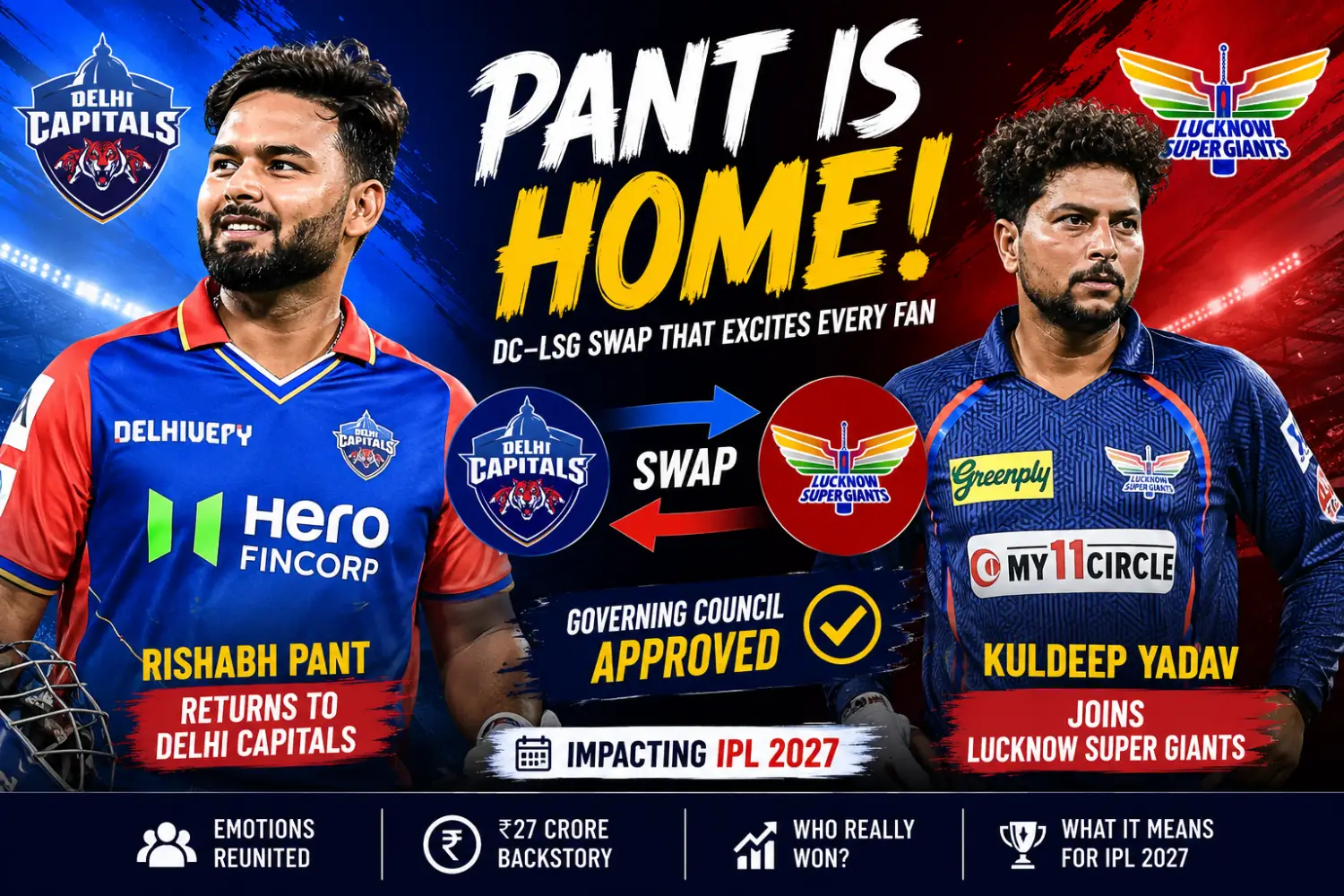
Some trades are business. Some trades are chess. And once in a while, a trade comes along that just makes people feel things. That’s what happened when the news dropped: Rishabh Pant is a Delhi Capitals player again.
The IPL governing council has officially approved a straight swap between Delhi and Lucknow Super Giants – Pant returns to the capital, and Kuldeep Yadav goes the other way to LSG. Delhi fans have been floating ever since. Let’s break down why this deal hits so hard, and why it’s smarter than it is sentimental.
First, the deal itself – no rumours, this one’s real
In an off-season drowning in “sources say” stories, savour a confirmed one. The swap is signed, sealed and approved by the league. Pant rejoins Delhi on a reworked salary of ₹15 crore. Kuldeep moves to Lucknow at his existing price, ending a five-year run in Delhi colours.
That ₹15 crore number is doing a lot of quiet storytelling, by the way – because the last time Pant changed teams, the figure attached to his name was very, very different.
The ₹27 crore elephant in the room
Rewind to the 2025 mega auction. Delhi, for reasons fans still argue about, let their captain enter the pool – and Lucknow Super Giants dropped a bomb: ₹27 crore, the biggest bid in the history of the IPL. Pant became the most expensive cricketer the league had ever seen, and from that exact second, every innings he played for LSG was weighed against that number. That’s not pressure; that’s a piano hanging over your head by a thread.
Two seasons on, the piano has been gently lowered to the ground. The move back to Delhi at ₹15 crore – a ₹12 crore markdown – is the market quietly admitting the original price was never going to age well. No shame in that. Auction nights run on adrenaline, and adrenaline is a terrible accountant.
Why this homecoming actually means something
Here’s the context for anyone who started watching the IPL last week. Pant isn’t just a Delhi player. From 2016 to 2024 – nine seasons, 111 matches – he WAS Delhi. He arrived as a teenager with a bat-swing that made bowlers file complaints, grew into the team’s most-loved cricketer, and eventually wore the captain’s armband. Through name changes, rebuilds and heartbreaks, he was the constant.
So when Delhi let him walk into that 2025 auction, a piece of the fanbase went with him. This trade brings both back. Franchise sport rarely offers a clean, happy reunion – this is one. Enjoy it.
Okay, sentiment aside – did Delhi actually win the trade?
Cold analysis time, because feelings don’t win playoffs. And honestly? Delhi’s front office deserves applause here.
Think about what they’ve acquired: a top-order wicketkeeper-batter with proven match-winning ceilings, leadership experience, and instant emotional buy-in from the entire fanbase – for ₹12 crore LESS than his last auction price. In a league where the salary purse decides titles as much as talent does, that discount is the real trophy. Delhi didn’t just get their guy back. They got their guy back and kept money in the wallet for December’s auction.
Add the squad-fit logic – keeper sorted, middle order stabilised, dressing-room identity restored in one move – and this is about as clean as trades get.
Now hold on – don’t you dare sleep on Lucknow’s side
Every trade breakdown does this thing where one team “wins” and the other gets mocked. Not here. Lucknow’s end of this deal is genuinely sharp, just less cinematic.
Start with the obvious: they’ve offloaded the heaviest contract in franchise history and bought back flexibility for a proper rebuild. Then look at who’s arriving. Kuldeep Yadav might be the most reliable white-ball spinner in India – a left-arm wrist-spinner who takes wickets through the middle overs AND keeps the run rate honest, which is basically the cheat code every T20 side is hunting for. He was quietly one of Delhi’s most dependable performers for five years.
If you’re LSG, resetting after the Pant experiment, that’s the perfect first brick: not a superstar with a superstar’s price tag, but a match-winner you can build an entire bowling attack around. Give the rebuild two seasons before laughing at it.
There’s a knock-on effect worth flagging for Delhi too, while we’re being fair: trading away your most reliable spinner leaves a very specific hole in the attack, and in a thin mini-auction pool, quality spin gets expensive fast. Don’t be surprised if a wrist-spinner sits right at the top of DC’s December shopping list – or if they skip the queue and solve it with yet another trade.
The verdict, scoreboard style
Delhi: the fanbase moment of the year, plus a marquee player at a discount, plus purse room. Big win. Lucknow: salary relief plus a premium spinner as their new bowling spine. Quiet win. Pant: freedom from a record price tag, back in the only dressing room where he’s never had to prove he belongs. Maybe the biggest winner of all.
Good trades leave both sides better off. This one does. Ask us again in May 2027, though – playoff spots are the only reviews that count.
Quick crash course: how do IPL trades even work?
Since trades are clearly becoming the league’s main off-season entertainment, here’s the two-minute version. Deals happen in designated windows outside the season and need three yeses: both franchises and the player. They come in two forms – direct swaps like this one, or all-cash moves where a franchise buys out a contract. Salaries travel with the player and can be renegotiated (hence Pant’s new ₹15 crore figure), and in cash deals a separate transfer fee can be paid on top, with rules allowing the player himself to pocket a healthy slice of it. It’s basically football’s transfer market wearing cricket whites.
And the trend is real: Robin Uthappa moved via trade, R Ashwin went from Punjab to Delhi, Ajinkya Rahane followed from Rajasthan, Cameron Green’s switch to Bengaluru helped build a title-winning core, and Hardik Pandya’s seismic 2023 move from Gujarat back to Mumbai remains the loudest trade the league has ever produced. The auction used to be the only marketplace. Not anymore.
Read More Blogs :
1. RCB Did It Again
2. IPL 2027
Why this trade is only the beginning
Here’s the strategic bit worth understanding: IPL 2027 is a mini-auction year. The December player pool will be shallow, which means franchises can’t fix big problems with paddle-raising – they have to fix them with trades like this one. Delhi and Lucknow just showed the league the playbook, and everyone else is reading it.
Case in point: the biggest name in the league is still stuck in a very public, very messy tug-of-war between multiple franchises as we speak, and Delhi themselves are reportedly not done shopping. Retention lists later this year will bring their own fireworks. The road to IPL 2027 runs straight through the trade market -and traffic is heavy.
Pant, meanwhile, gets to ignore every bit of that noise. His jersey says Delhi again. For him – and for a few million Delhi fans – that’s the only headline that matters.
[ Log In Our Website ]


