



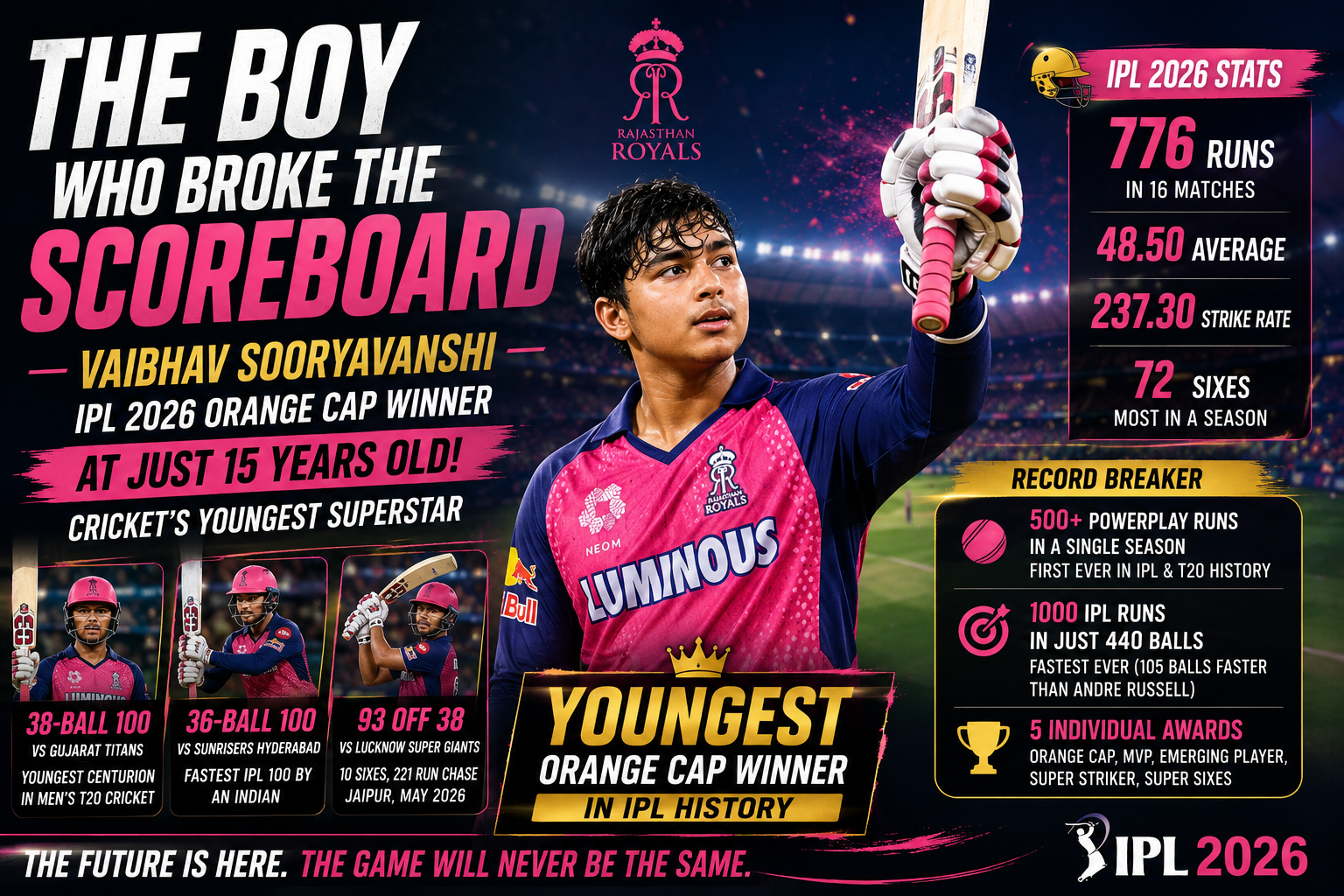
Every few years, cricket produces a player whose numbers make you check the source twice. Usually the disbelief fades once you remember the context — a flat season, a small ground, a weak era. Vaibhav Sooryavanshi’s IPL 2026 offers no such comfort. The numbers are real, the bowling he faced was the best in the world, and the player who produced them cannot yet vote, drive, or legally sign his own contract.
At fifteen years old, the Rajasthan Royals opener finished as the leading run-scorer of the nineteenth IPL season — the youngest Orange Cap winner the league has ever had, by a distance that will likely never be threatened. This is the story of how he did it, and why the 2026 season may one day be remembered less for RCB’s second title than for the arrival of the most precocious batter the game has produced.
From a Bihar village to a ₹1.1 crore bid
The origin story already borders on folklore. Sooryavanshi grew up in a small village in Bihar, and by thirteen had made history before facing a single IPL delivery — becoming the youngest cricketer ever entered into an IPL auction, where Rajasthan Royals, who had scouted him at trials, secured him for ₹1.1 crore at the 2025 mega auction.
What followed removed any suspicion of gimmickry. Handed a debut in IPL 2025 at fourteen — the youngest debutant in the league’s history — he needed only a few weeks to produce the moment that announced him to the world: a 38-ball century against Gujarat Titans in Jaipur, an innings of 101 studded with eleven sixes that made him the youngest centurion in all of men’s T20 cricket and the scorer of the fastest IPL hundred by an Indian. Cameos of 40 off 15 and a composed 57 against Chennai confirmed the century was no accident. The world braced for season two. Nobody braced enough.
The 2026 season, by the numbers
Sooryavanshi’s full 2026 ledger reads like a misprint: 776 runs in 16 matches at an average of 48.50 — and a strike rate of 237.30, the highest ever recorded by an Orange Cap winner across the league’s nineteen editions. He didn’t merely score more than everyone else, including established stars like Shubman Gill and Sai Sudharsan who chased him all season; he scored nearly two and a half runs per ball while doing it.
The records fell in clusters. He struck 72 sixes, a new mark for a single IPL season. He hammered a 36-ball century against Sunrisers Hyderabad — improving on his own teenage benchmark. He became the first batter in the history of not just the IPL but any T20 tournament to score 500 powerplay runs in a single season, redefining what the first six overs of an innings can produce. And along the way he reached 1,000 career IPL runs in just 440 deliveries — 105 balls fewer than the previous record-holder, Andre Russell, which is roughly the statistical equivalent of lapping the fastest man in the field.
There were signature nights within the blur. Against Lucknow in Jaipur in mid-May, with Rajasthan’s playoff hopes on the line, he walked in as an Impact Player and detonated 93 off 38 balls — seven fours, ten sixes — to run down a target of 221 and drag his team into the top four. Mitchell Marsh’s 96 for the opposition that evening was, remarkably, a footnote.
The playoff crescendo
Prodigies are often accused of feasting in low-pressure moments and shrinking in high ones. Sooryavanshi’s response was to save his most absurd cricket for the knockouts. In the Eliminator against Sunrisers Hyderabad, he blasted 97 from 29 deliveries — an innings of such violence that it effectively ended the contest inside the powerplay. In Qualifier 2 against Gujarat Titans, with a final on the line, he made 96 off 47; Rajasthan fell short of the final, but their teenager had delivered near-centuries in consecutive knockout games.
When the awards were handed out, the sweep was total: the Orange Cap, the Most Valuable Player award, Emerging Player, Super Striker and Super Sixes — five individual honours in a season where his team didn’t even reach the final. He also finished as the highest-scoring uncapped player in a single IPL season, a record that doubles as a countdown clock on the word “uncapped.”
The team that built the launchpad
Credit belongs, too, to the environment around him. Rajasthan Royals — coached by Kumar Sangakkara and captained by Riyan Parag, splitting home games between Jaipur and Guwahati — finished fourth in the league stage and constructed their batting to weaponise the teenager rather than shelter him. His opening alliance with Yashasvi Jaiswal became the most electrifying top-order pairing in the league, two young left-handers with a combined age under forty routinely deciding matches inside six overs. With Jofra Archer leading the attack with 24 wickets, Rajasthan rode their prodigy all the way to the Eliminator — and it was fitting that when they finally fell, it took the eventual runners-up to stop them.
The franchise’s history with young talent is worth noting here: this is the same team that handed debuts and platforms to a generation of Indian stars. Sooryavanshi may be the most spectacular graduate the academy model has ever produced.
What this means for IPL 2027 and beyond
The immediate question for next season is tactical: what, exactly, do bowling units do now? A batter who scores 500 runs in powerplays alone breaks the basic economics of the phase — captains can no longer plan to “see off” the opening bowlers when the opening batter treats them as the easiest overs to attack. Expect 2027 to feature visible counter-strategies: spin inside the first six, wider lines, funkier fields. Expect, also, that a fifteen-year-old with this learning curve will have counter-counters ready.
The medium-term question is financial. Sooryavanshi remains on his original ₹1.1 crore deal — arguably the most lopsided value contract in franchise cricket — and with the next mega auction arriving ahead of IPL 2028, Rajasthan’s single most important strategic priority for the next eighteen months is simple: retain him at any cost the rules allow. Every other franchise’s priority is equally simple, and exactly opposite.
And the long-term question is the one Indian cricket is quietly savouring: how soon does the national team come calling? On that, patience is a virtue — the boy has time, in the most literal sense any athlete has ever had it.
A season that changed the sport’s imagination
Great seasons redefine what’s achievable; historic ones redefine what’s imaginable. Sooryavanshi’s 2026 did the latter. A batting average of 48 at a strike rate of 237 was, before this year, a video-game setting. Now it’s a data point — set by a player who won’t turn twenty until the next decade.
RCB own the trophy, and deservedly. But when historians pick the image that defines IPL 2026, it may well be a fifteen-year-old from a Bihar village, launching another six into the Jaipur night, while the scoreboard operators struggle to keep up.


